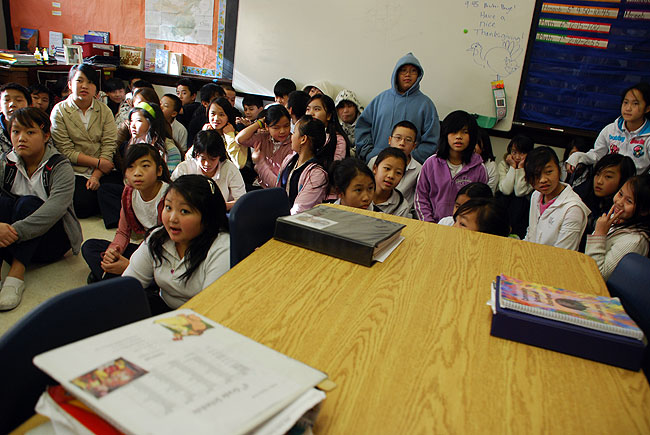
Secretary of Education Arne Duncan talks about the importance of getting the balance right in the curriculum.
Some food for thought for all educators. We are all in the business of bettering the next generation for an unseen future.
"The best ideas always come at the local level. Not from me and frankly not from anyone in Washington"
The Global Transformation in Education addresses the forces of change that are causing educators globally to rethink what education for today’s students should involve. Mark Treadwell author of The Perfect Storm discusses the collision of three “storms” that are now rocking the world. Read more…
Plane Project
The PLANE project seeks to develop a suite of on-line learning experiences to meet the needs of today’s teachers. A key feature of the project will be its utilisation of two environments for the delivery of the online experiences:
a 21st century immersive learning environment – a “digital virtual world” for experiential learning, problem based simulation learning, collaboration and communication.
Private schools or independent schools are not administered by government therefore they retain the right to select their students and are funded in whole or in part by charging their students' tuition. They are free to choose their own curricula and select, for their students, the examination system they desire.
Charter schools are schools that receive government money but are not subject to some of the rules, regulations, and statutes that apply to other schools. While charter schools provide an alternative to other public schools, they are part of the public education system and are not allowed to charge tuition.
Public schools or state schools, generally refer to primary or secondary schools that offers all children an education funded by the government, and paid for, in whole or in part, by state taxes.
There is much in the news about the introduction of charter schools in New Zealand. And it seemed to be kicked off by the announcement:
There will be much debate over the issue and even in these early days there is a mix of opinion from stakeholders. Trying to pull the fact from the opinion is going to become something of a headache, as with all these things there are pros and cons to both sides of the argument.
A neurologist says that if he can get to a stroke victim within 3 hours he can totally reverse the effects of a stroke...totally. He said the trick was getting a stroke recognized, diagnosed, and then getting the patient medically cared for within 3 hours, which is tough.
Sometimes symptoms of a stroke are difficult to identify. Unfortunately, the lack of awareness spells disaster.. The stroke victim may suffer severe brain damage when people nearby fail to recognize the symptoms of a stroke.
Now doctors say a bystander can recognize a stroke by asking three simple questions:
S *Ask the individual to SMILE.
T *Ask the person to TALK and SPEAK A SIMPLE SENTENCE (Coherently)
(i.e.. It is sunny out today.)
R *Ask him or her to RAISE BOTH ARMS.
If he or she has trouble with ANY ONE of these tasks, call emergency number immediatelyand describe the symptoms to the dispatcher.
NOTE: Another 'sign' of a stroke is this: Ask the person to 'stick' out his tongue. If the tongue is 'crooked', if it goes to one side or the other that is also an indication of a stroke.
A cardiologist says if everyone who gets this e-mail sends it to 10 people; you can bet that at least one life will be saved. Tweet
New Zealand Education leads the way
globally. I am sure that there are innovative and engaging teachers across New
Zealand who have a story to share.
TED 2012 are launching TED ED next year and
they are wanting you to nominate educators that would be willing to share with
the world.
In their blog post they write:
For the upcoming TED conference TED2012:
Full Spectrum we’re looking for 10 of the world’s best teachers to take the TED stage during a special session we’re calling The Classroom. We’re accepting
nominations to help track these people down. You can nominate yourself or a
remarkable educator we should know about — who doesn’t have to be a teacher in
the traditional sense.”
The article linked to above, if it is to be believed then there is mounting hysteria when it comes to sex education in schools.
According to an MSN NZ poll asking readers if NZ schools were going too far when teaching children about sex it seems the response was fairly even between ‘yes’ and ‘no’. Which seems to be in direct conflict with the ‘outrage’ splashed across the headline.
So what is the policy?
TKI site points out that “The Education Standards Act 2001 repealed sections 105C and 105D of the Education Act 1964. School boards of every state school must now implement the health curriculum in accordance with section 60B of the Education Act. Previously, schools had an option to exclude the sexuality education components of the curriculum.
It also states that:
Students require a range of developmentally appropriate learning opportunities in sexuality education. These include opportunities to develop:
knowledge, understandings, and skills relating to sexual development –physical, emotional, and social;
knowledge, understandings, and skills to enhance their sexual and reproductive health
I think the issue is not the content of the curriculum just the age at which it is delivered. If the .
KiwiFamilies point to the necessity for the school to inform parents that sexuality education is the focus of learning at any given time. They go on to say that a school should inform parents via a newsletter and to invite parents/caregivers to an information evening.
The stats to which he refers reveal the following:
40 per cent of school children in Pacific Island countries do not complete a basic primary education
only 20 per cent graduate from secondary school
Girls have real issues with access to the formal education system in several countries.
So what should New Zealand's response be?
Many of the issues have at their heart economics and not education. There is genuine potential for investor in supporting Pacific nations’ development of ‘tourist friendly’ facilities and pouring, at least some of the earnings back into the communities that generate that income.
But the issue for us is education. The question for educators should be:
“ Would the funding of ESOL trained teachers in these Pacific nations offset some of the financial burden placed upon New Zealand schools in supporting Pacifika students?"
Copyright continues to be a minefield for all, educators especially. And when teachers are to be role models to our use their understanding of such laws is important.
A public education campaign has been launched to highlight the new Act, which includes a public service announcement screening in cinemas nationwide, as well as the www.respectcopyrights.co.nz website and further educational materials for internet account holders.
National advertising campaigns are good ways in which we can target the mass audience that is the general public but teachers and other professionals need more.
There is a call now for a clearer understanding of copyright, what it means to individuals and schools. Someone needs to start pounding the streets talking to staff about roles and responsibilities. But more over, senior management needs to see this professional development of their staff not as fee but as an investment. Not having to spend several hundred dollars to have someone come in a talk to staff but needing to make the savings on the possible fines involved in non-compliance.
In an election year, no less. The Principal’s Federation seems confident that some agreement can be reached about ‘off-limit’ areas of the education sector.
Western Bay of Plenty Regional PPTA chairman Jason Smythe is quoted in Sunlive as saying: “Change in the sector is usually due to political point scoring as opposed to what is in the best interest of our students. Teachers are left trying to pick up the threads of ill-constructed ideas which often see more administration rather than them being able to focus on their core role – teaching in the classroom.”
Currently, according to OECD figures New Zealand has the best education system in the world. That achievement has arisen through the current system as it stands. But without healthy debate and discussion and the right to protest and even ‘political maneuvering’ then we wouldn’t have the robust democratic process we have now. If Education were decreed ‘off-limits’ for political discussion then the outcome would be a slowing of change in education and a shifting of accountability that may or may not be healthier.
The level of debate over education needs increase, not decrease.
It seems that the behavior of our our very youngest students is deteriorating.
Surely, at age five or six any blame directed at school or schooling practices is minimal.
Those early years are dominated by parenting and ECE.
Quality parenting skills are a prized treasure by one sector of New Zealand society and viewed as a complete waste of time by another.
Sterotypes are unhelpful here as both these views are help by people across the economic/ social/ cultural divide.
My point being that the importance of parenting skills and lifestyle choices continue to impact upon kids right through their childhood.
Again this article serves to highlight my point that it is the parent who should be the champion of their child’s education and teachers/ coaches/ tutors are mere subcontractors.
These passed two days has seen me meet in Wellington for discussions about access to web content for all.
Many blogsand wikis and websites are constructed by the physically able and have very little regard for those individuals with hearing or sight impairments trying to access content. When I say “many blogs” I am including this blog as chief among them.
There are many differences you may or may not be aware of if you compare this post with many previously. In this post I hope to highlight some ‘best practice’ principals that I have learnt over these last two days.
Creating the right heading structure
First amongst the changes are the number of headings you’ll notice. When writing on the web, or in WORD, you may have noticed the ability to label text as ‘heading 1’ , ‘heading 2’, ‘heading 3’ and so on. As pretty as these may look they actually serve a more serious purpose. This type of heading structure assists those visually impaired to navigate through your article. Just as ‘chapters’ in a DVD enable viewers to scroll through a movie more quickly or select the scene they desire so the navigation tools scroll through the article using these heading 1, heading 2, heading 3 as markers or reference points to guide the user to the most relevant paragraphs for them.
Making links meaningful
Many screen reader navigation tools have ‘links’ as a scrolling option for users but in many cases they don’t receive the in information they most desire. Instead a the voice reading stating “Link, getting the most the from a webpage” or “Link, further reading supporting accessibility of websites” all the user will hear is a string of “Link, read more” or “link, click here” which gives no guidance as to the content found at the end of the link.
Therefore it is advised that ‘click here’ or ‘read more’ are to be phased out with links becoming part of the main body of text, comprising of complete sentences.
Annotating images for accessibility
Using captions effectively
Figure 1 Rusted car in long grass
We are going to stay away from the issue of copyright and ‘where did you get that image?’ and move straight to the features of the image of an old car in long grass (figure 1) you see to the right. The first thing you’ll see is that it has a caption with a title which links it to this paragraph you are reading right now. Captions add meaning and context to images.
Alt-text to support understanding
What you can’t see, unless you have screen reader on is the ‘alt-text’. In a nutshell the alt-txt or alternative text to give it its full title is a brief description of content of the image. Alt-text is only included if the image or information contained on the image is significant in its support of the main body of text.
Alt-text for bling
Otherwise it can be simply ‘bling’. This is where the content of an image is merely there for aesthetic purposes and contains no content to actively support the article. Still the writer needs to make a conscious decision to add alt-text for this image even if it is only the word “null” so that those using electronic readers can identify ‘bling’ and know they are not missing out on important information.
Captioning and transcripts for video presentations
Our responsibility for providing quality video examples does not simply rely on quality camera work or clever editing. You will notice with the embedded video below it has closed-captions options and an embedded transcript. Writing a transcript of a video can be time consuming and tedious, however, it is essential if we are going to ‘raise the bar’ in accessibility. Youtube has a built in feature which supports in creating the time-coded captions from the transcript.
Today we arte going to be talking about accessibility for websites. Music. Whether we are responsible for writing a formal website or doing our own blog we need to be aware that there a certain group of people who access the internet in a different sort of way. They use screen readers and electronic Braille typers and all sorts of other different gizmos in order to access web content. Everything we post needs to be accessible. You know wen you are writing a blog post or you’re in some sort of editing tool you’ll notice at the top that it has by the side of font it has ‘normal’ ‘heading 1’, ‘heading 2’, ‘heading 3’ , normally it’s a drop down menu. Now these make your blog post look really, really pretty but they actually serve a more serious purpose. If someone is using a screen reader access your website then these headings clearly demarcate and help them to navigate through your website. That’s the way they skim and scan through your document. When one of those electronic voice, activation, tool, things. Stop captions now. When they are being used. One of the ways of navigating is to click through the links on a page. Now if we always write ‘read more’ or ‘click here’ or ‘see more’ and use those turns of phrases for our links that ‘s all they are going to here. And its going to make no reference at all to where that link ends up. So we need to get rid of those things and we need to basically make the link either a whole sentence or a portion of the sentence that when it is read by the screen reader they have a clear indications as to where that will take them. The next thing we have is what we have to do with images. It blew my mind when I was in the session. Essentially, there are captions, and descriptions and alt text. Alt-text is the one, you when you hover over an image and it comes up in maybe a yellow box or something like that. Sometimes it appears like that, and sometimes it doesn’t appear at all. It either needs to be a full bright sentence to describe what’s going on in the picture and why it is useful to the main article or it simply needs to read null. Or something like that. So its basically bling on your site. And when the screen reader goes through and the user is there they know that the image is just there to be pretty and I’m not missing out on anything to do with the main article and I’m just skipping passed this image. So now we’ve come to the portion about, well, basically, this video. Because what I’m hoping to do. First of all you should have been seeing captions of everything I’ve said. I’m not sure how they are going to spell *rasp* There should be a transcript attached to this post. Ok so, there is going to be more helpful links in the shownotes below. Don’t forget the closed captioning that we’ve got and don’t forget to subscribe at the top and good luck. Music.
Useful links
Web aim is about information, training, resources, guidelines and standards for Web accessibility and disability access to the Web. The World Wide Web Consortium (W3C) is an international community that develops standards to ensure the long-term growth of the Web. WAVE is a free web accessibility evaluation tool provided by WebAIM.
I’ve been watching ‘Penguins of Madagasar’ with my son this week so when I read that ‘BFF is just a bully in disguise’ in the Herald this morning I can’t help but be reminded of the line “King Julian’s a Buffalo Fire Fighter”
The problem of bullying is a broad and widespread as it is diverse in its forms.
More often than not it begins a friendly banter and ‘joshing’ and often goes unidentified for quite some time.
The social issues around teenage girls are vast and complicated. The research pointed to many istances of bullying beginning over boyfriends and jealously.
But there is some direction available. Where the issues that prompted the bullying are most dealy felt by the individual then …
"Despite out best efforts it tends to be on the increase and regrettably it often tends to result in girls leaving the school because the relationship can't be restored which is very sad."
But if engagement in sport and other activities outside of the school environment hold more weight for the individual then there is a increase likely-hood that a healthy perspective is maintained for the individuals involved.
When asking Stephen Fry a question is a mere tweet away and being able to ‘Facebook’ ONE News or some All Black or other distance between ‘celebrity’ and the 'everyman' is narrowing, fast.
Gone are the days, far, far in the past, when politicians answered to their public via TV spot or Town Hall presentation.
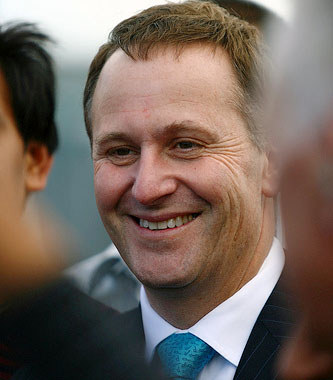
John Key’s personable nature and willingness to share ‘his personal opinions’ whether it be in meetings such as that described in the Otago Daily Times or with his regular Youtube updates, it certainly endears him toward the New Zealand public.
He shared:
"If you smoke, the blunt message is stop. Nothing is more sure to kill you than smoking."
His personal view [on purchasing alcohol] was 18 years in bars, restaurants and controlled premises and 20 years for off-licences.
Whether we agree with these positions or not they are very clear. Raising the level of debate in this country, surely that's a good thing.
Does a degree really mean increased job opportunities, positive and balalnced lifestyle choices and a healthy outlook on life? Richie Poulton hopes to find the answer to these and other questions over the next 10 years.
Final year graduates will receive a email today to determine if they are one of the selected few to participate in Richie Poulton’s longditudinal study into the impact, positive or negative of having a graduate degree in 2011.
"Participants will fill in an online survey designed to reveal how their careers develop, when they begin to have families, where they live, their finances, health and social relationships. "We want to make this the most comprehensive examination of lives and careers of a graduate population in the world," says Poulton."
I know that. You know that. But isn’t it great to be having the importance of teaching highlighted in a positive way.
"...Henry says he was also a keen advocate of athletes pursuing an academic career, which was an important way of finding the right on and off the field balance..."
It also nice to know that when the boots are hung up then there is a life beyond the field. I know most of us never get to play at a high level but even so. A sporting career really only lasts a fleeting few years at best and then ‘normal life’ has to kick in.
For the vast majority of those 'dreaming of being an All Black' it remains just that, a dream. ‘Normal life’ is what we work towards from the beginning.
With a solid education behind each of us we have the opportunity of greatness in own field of expertise.
Solid careers are built on positive role models and sound education.