Showing posts with label parenting. Show all posts

Some solutions to the challenge of summer parenting


Contributed by Simon Evans

As the school year draws to a close teachers are all probably breathing a sigh of relief whereas many parents are somewhat daunted by the prospect of offspring at home and having to juggle work commitments. It can be a stressful time.
Here are a few suggestions that help me so they maybe helpful to you.

‘Play-days’ – Come to an arrangement with friends to share the load of child monitoring by offering to have their kid over for the day and another time they can have your… you never know they may just spend the day playing together and leave you alone to get some work done.

Summer holiday programmes – There may be a holiday programme running in your area. They don’t normally cover the full six weeks but you may fill a week or two, your kid may even pick up a new friend or two.

Kiwi Families activities – offer a raft of craft ideas fro all ages. It seems you’ll need to supervise but at least it beats crawling around on the floor with the army figures for the 900th time.

Routines – if you’re away in Fiji fro 6 weeks of the summer all well and good for you but for the rest of us its probably a week here or there. The rest of the time needs managing and routines are the answer. Help establish an ebb and flow to the days by scheduling busier and quieter activites. Alone activities and times when friends can come to play.

‘Homework’ – To avoid your kid’s brain going to mush over the holidays it may be a good idea to establish a work pattern. Some reading, writing, a little maths. I’ve just identified my kid is somewhat shaky with telling the time- that’s gonna be our little focus over the hols.

Reading programme – Libraries around the country have been given funding to support child literacy by providing so incetives over the holidays – this year has a ‘legend’ theme about, certainly where we live.

Whatever you do make some time is quality time.

Good Luck!

5 tips for staying safe on the web


  • Choose strong passwords
  • Enable 2-step verification
  • Install updates right away
  • Be wary of suspicious emails and offers
  • Scan regularly for viruses

Holiday activity plans for the kids


School holidays are just around the corner for us and I've been freaking out as I've got to study (Uni exams in a few weeks and I'm way behind as usual). Generally I have no plan and we have a few playdates but generally it's bedlam & chaos & I get to the end & think "how could I have done that better?" and then forget about it for another couple of months.

This holidays for some reason I've decided to plan ahead. I am a mean mummy in that every morning of the school hols I expect my kids to write a story, with a picture. Mostly this is because I love reading the kids stories, but also because I love to see their progress from term to term and additionally I want to keep them busy.

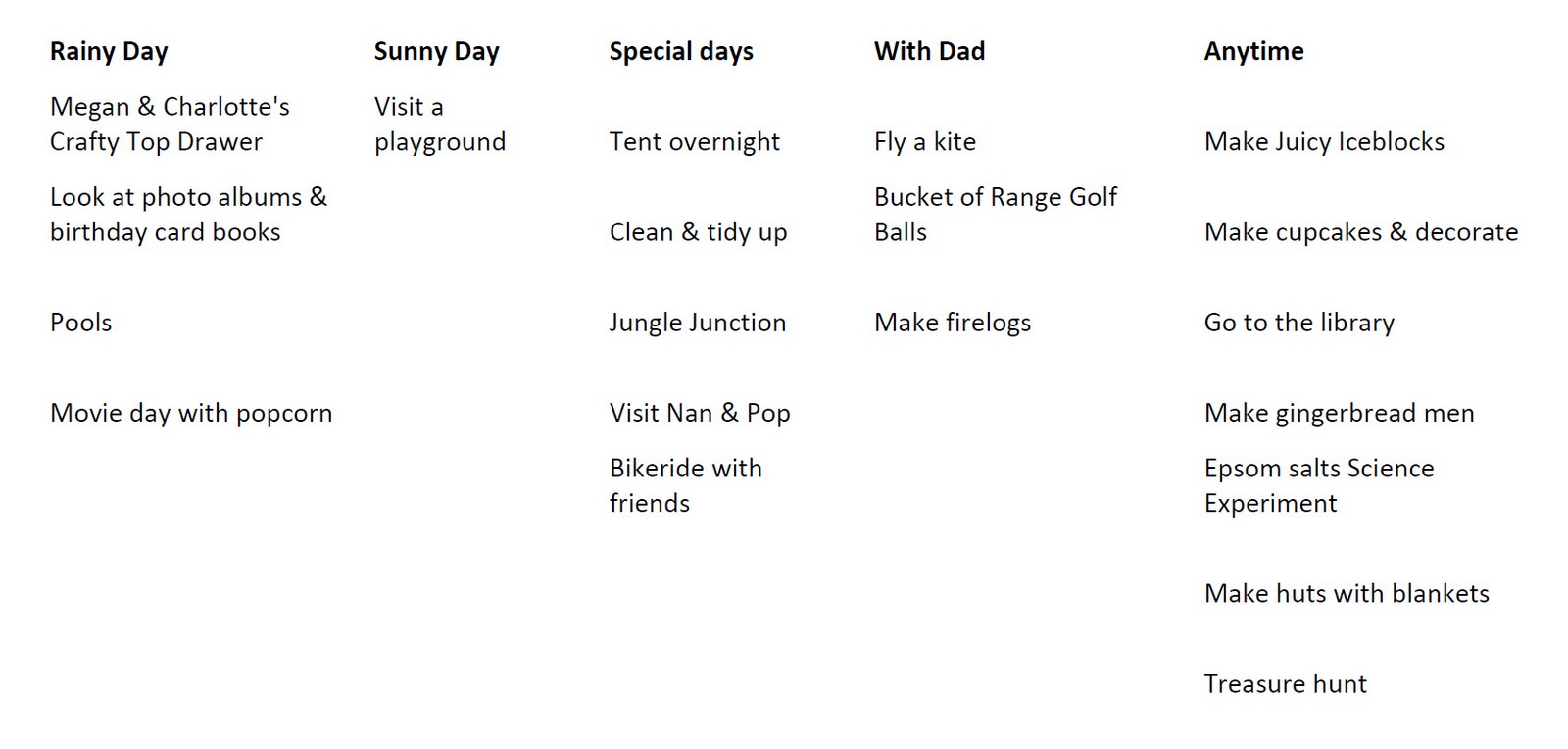
I've decided that after they've written their daily story, they can choose from one activity from my newly formed "lucky dip bag" of things that we'll do together, so they have something to look forward to & I have something that I need to do with them before I hide back in my corner with my books & tell them to "go play" & "be good" & "stop fighting."

I've attached my ideas to the right there. I've printed each column in a different colour, so on a rainy day someone can choose a red piece of paper & when Dad's home they can choose a blue piece or on special days I can raid the bag first & pull out all the orange pieces except 1 before the kids get to it.

Anyway, the plan is in place. Will it still turn to bedlam & chaos? More than likely, but hopefully it will be better than other times. When it all turns to rubbish and you want a giggle, then check out the crappy pictures blog
Contributed by RosieO


Top Tips for School Mornings


They’re fun, aren’t they? School mornings are one of the most difficult times of the week. In our house, we allow an hour and ten minutes to our kids ready for primary school each day. I think if the kids had their own choice they’d spend that whole time giggling at the breakfast table or drawing on the bathroom mirror with their toothbrushes. So below are some top tips for that have worked in our house.
1-Write a job list, down to the completely obvious like ‘put your shoes on,’ with words and pictures, if you have pre-readers. Place it in some prominent place where they can see it and it’s out of your way.
2-Encourage your children to self manage using the job list. Hopefully this should lead to them referencing the board rather than you every 2 minutes.
3-Limit eating time. I don’t know about you, but if my kids are at the breakfast table after 30 minutes they’re generally spending little time eating and most of their time talking, annoying each other or driving me nuts. 30 mins is plenty of time to eat your 6 weetbix or 2 bowls of muesli.
4-Keep the long term goals in sight. Sticking up a list is not an instant answer to all your morning problems. If your kids have been asking you for the last 3,5,10 or 15 years what they have to do next they will continue to do so unless you give them another solution.
Lastly, be encouraged – everyone has terrible starts to their mornings sometimes
Contributed by RosieO

Dr Jo Anne White discusses Autism with Timmy Elmer and Dr. Robert Melillo

Timmy Elmer, 15 years old, was diagnosed with Aspergers and ADHD at 3 years of age. For many years he preferred video games to friendship. His anxiety made it very difficult for him to try new things and he had significant behavior difficulties. In the third grade he was removed from general education and placed in behavior programs.

He returned to general Ed in the 6th grade and has been in a self-contained class with a one on one aide. Timmy's managing life much better these days. He's now in high school and is a part of the lacrosse team. His companion dog, Boola, and he get out of the house on many adventures.
Listen to internet radio with Jo Anne White on Blog Talk Radio

Recorded by Jo Anne White on blogtalkradio on Thurs, Aug 25, 2011

Thoughtful fablevision


A powerful tale written by Peter H. Reynolds. Animation and Direction by John Lechner and Peter H. Reynolds. Executive Producer, Gary Goldberger.

So...

Are you nodding toward your dream?

Murder rips mercy's heart out.

“During the sentencing, Judge Clapham asked Ms Baker, who was sitting in the public gallery, to "tell him what you need. You know better than me". Ratana wiped away tears as he listened to the weeping woman tell him she loved him and wanted them to have a decent life. She had stood at the back of the courtroom, looked at Ratana and told him she wanted him to change for himself.”


This story is tragic on many levels. Lives will ever be the same. The implications of these actions could have far reaching implications than first realized.

The loss of child is obviously the most devastating for family, for friends, for us all. To think that so much potential is snuffed out in one violent moment.

That poor mother, asking the judge to give her partner a chance. The hope for a better future so dear to her heart. Such betrayal. How could you feel that you could trust another human being ever again.

That poor judge. Responding to the initial case with such mercy. How many future defendants will miss out on that compassion as the judge prefers to deal in justice, fearing the consequences of a merciful heart.

Indeed a tragedy.

Auckland's Measle epidemic rising


Is it not interesting how the focus on your mind seems to bring issues into sharp relief?

I have just watch “A walk in the woods” an episode of ER featuring a child who is presented as having measles. Dr Carter claims 4 in 500 die from the disease,. I doubt the stats are accurate in the first place let alone 5 years on but still, the issue of whether to have your child immunized is still very much debated.

Auckland's measles outbreak is worsening with 50 people now confirmed to have the disease, a number expected to rise.


"Common symptoms of measles include a runny nose, cough, sore eyes and fever followed by a raised red rash that starts on the face and spreads across the body.
Hoskins said anyone displaying symptoms of measles should ''immediately'' telephone their doctors, or Healthline on 0800 611 116, for advice." 

'It is important to call ahead, measles is highly infectious and people with it can infect others in the waiting room.


The Parenting Show with Pio – 6 July

Wed 6 Jul, 10:30am–12:00pm

Where: Te Horo School,  3239 Pipiwai Road, Pipiwai, Maungatapere
Restrictions: Over 15
Admission: Free

Care for a korero with Pio Terei? 'Become a Parent Coach' - come and hear Pio's down to earth ideas on how to be a choice parent. Especially designed to inspire and equip Maori parents and caregivers for the awesome role they play in their whanau.
Entry by gold coin donation.
For more information contact Cheryl or Rongamau ph. 09 438 6453
Email: admin@tehoro.school.nz

Other dates:


Training your kid to cross the road is harder than you think

There are many courteous road users in the provinces compared to the main centres of New Zealand but its not always the most helpful.

Understanding traffic and road safety doesn't necessarily come naturally. We need to teach our children how to be safe pedestrians. It's not just about telling them what to do - children learn from what adults do, so you need to model safe behaviour.

So with that in mind we took to the streets this afternoon. Whilst trying to train my 5 year old to cross the road with care I got somewhat frustrated by the number of drivers who saw I was with a child, slowed to a stop and waved us across.

They are good and kind people but I do not want to give my child the impression that cars stop for you when you are wanting to cross the road. Under no circumstances do I want him to be under the illusion that it is the drivers’ responsibility to ensure his safety.

We walked the city centre of Hastings looking for crossings and opportunities to talk about ‘sneaky driveways’, different places to cross and dangers of parked cars. I’m hoping he is a little wiser today but the trick to this is to take EVERY opportunity your can to reinforce these lessons. Here’s hoping we can take five more minutes in our journey to do it right.

Little eyes are watching and learning from actions.

Resources are available to assist us in educating our kids:

The father/son bond

With a three weeks remaining  of solo parenting gig I'm beginning to wonder what it is that makes may connection with my son so strong. He was born with the same hair as me and the eyes of my wife. At a month old it was totally the opposite. He shares my ridiculous sense of humour. He is honour bound to laugh at my silly antics, but the connection goes deeper.
Although he is five now and in school there were many nights, when he was first born that he spent asleep on my chest beneath the blanket. I have often thought that those precious moments sealed a bond between us that is like no other. But I may be wrong. Te cause could be more basic than that, more biological, more neurological.

Brian Mossop, from Scientific American states:
"Since there's no clear physical connection between a father and his child -at least not like the one seen with mom and baby- researchers are starting to look deep in the brain for better clues to understand the power of this relationship. A recent wave of studies are starting to bear fruit: We are now learning that in the first few days after birth, changes occur in the brains of both the dad and the baby, depending on whether the father is around or not. Perhaps neuro-scientists have finally cornered the elusive father-child bond, and found the biological hook that makes sure a father sticks around after birth."
Related links:
Questions arising about the teenage drink problem
Parents still control the future

Child Protection Training Programme adds new dates

  • South Auckland – 18-22 July
  • Central Auckland 25-27 July
  • North Shore 7-11 November
New Zealand is one of the only OECD countries that does not have mandatory child protection training for people working with children. Many of the key people in NZ working with children have not had sufficient training in knowing how to identify suspected child abuse and act confidently. Professional training in child protection WILL make you more effective in keeping children safe

Our kids should be choosing life

FEELING disconnected from Pakeha culture heightened the risk of suicide among young Maori, an international study found.  Reported the SundayNews

click to enlarge
The article is written in such an emotive way as to enflame the debate over Maori youth.
Perhaps the figures indicating that Maori youth suicide is effectively double what it should be, representing 20% casualties. However, there was no reference to the remaining 80% and how they breakdown in terms of ethnicity.

Disappointingly, there is only quoted reference to the study carried out by Terryann Clark. I for one would have liked to have gone and read some of the source material.

I’m not saying Maori youth suicide is not a tragedy. Far from it. Youth suicide is tragic period. I mourn the loss of a single life from such a totally preventable manner.

There is clearly a disconnect between many youth and their parents. Without the feeling of unconditional love that we can only receive from our parents then life can be brutal. Friends are friends, but they still can let us down. Teachers play their role as do social workers and pastoral care workers, yet still it is the closeness of family that really counts.

Kids need to feel wanted and needed. Even during times when they themselves refuse to acknowledge that need. Through the good and the bad family needs to be there.

Today’s families look very different to those a few years back. But regardless of what a kids family is made up of they need that safe place to be alone. To be with those who will love them regardless. Provided that ‘home’ is a supportive place then we all can bear the trials of the wild-world outside.

Let us all love, support and care for those kids in our care.

Useful link:
Teenage suicides- OECD report (87.6k, pdf) Last updated 20/12/2010


Cyber-Safety: What can you and your school do?

Brett Lee is fast becoming a leading expert on Cyber-safety and what young people need to be aware of while navigating social media sites.
His unique experience in the cyber-crime unit enables him to share with teachers and parents some of the dangers facing students today and some of the simple precautions they can take.

Back in February he was the keynote speaker at Learning@Schools conference in Rotorua. View his keynote address below.


Things to do:
Use Brett's keynote to provoke staff meeting discussion this term. 
Book Brett to visit your staff and parents
Subscribe to Edtalks
Subscribe to Brett’s newsletter
Join the Software for Learning discussion about Facebook

Healthy Kids Healthy Education

Thousands of young people are failing at school because of undiagnosed health problems, a research project shows.

The statistics that came from this study are alarming:

  • 315 in the original cohort needed a medical referral
  • 85 individuals needed eye treatment
  • 53 who needed glasses
  • 147 needed dental work
  • 12 needed ear treatment.

Apparently, health care free and access to GP’s is good. It is just that parents are not taking their kids.
There are several questions that need posing:
  1. What is it that is the barrier to parents not taking their kids for a check up?
  2. How effective is the school nurse/ dental programme at identifying need?

This is fast becoming an argument for schools to broaden their scope of care and become the ‘one-stop-shop’ for children’s needs.
Education + Health + ??

So what will address this discrepancy, allowing our children to maximize their potential…

Answers on a postcard to the usual address.

Questions arising about the teenage drink problem

Coroner Gordon Matenga said no one person is at fault for the death of the 16 year old who died as a result of alcohol poisoning following a party in Auckland's Grey Lynn on May 8 last year.


  • At what age should people be allowed to drink? 
  • How much legislation should there be? 
  • How much is it down to parental engagement ? 
  • How much responsibility should be placed on the the individual and how much upon their peers?
There must be a thousand factors impacting upon the events surrounding the teenagers death. Some immediate and some from long ago.Where to from here?

Again this is a time for us all, from all sectors of society, to take a long hard look at our responsibilities.
Law makers, law enforcers, teachers, parents, social workers, off-licence owners, bars and puts and club owners, friends and relations.
We should all play our part.

Further reading:
Why Do Adolescents Drink, What Are the Risks, and How Can Underage Drinking Be Prevented?
Alcohol Advisory Council of New Zealand
ACT - Raising Age Limit Won't Solve Teen Drinking (opinion piece)
DRINKING IN NEW ZEALAND National Surveys Comparison 1995 & 2000


Ideas for supporting kids through the hols.... plus a funny poem

Afina Izzati from
xchoshe.blogspot.com/
Homework these holidays can be a real pain. Trying to keep kids occupied and engaged in their learning. Especially if they have only been in school for a few terms, total.

There are a few suggestions for making time at the computer active, engaging and educational.

  • Spelling City allows you to input a few choice spellings from the past term and leave them to follow the activity though to conclusion, learning the spellings while having some fun.
  • Wakaaranga Primary School’s wiki is loaded with online activities for Year 1’s covering Numeracy and Literacy.
  • The BBC schools/typing activity, actively engages kids in learning to touch type.
  • The Khan Academy supports students of all ages to develop in their competence in maths.
Hope your kids have a great Easter and stay safe.

Jack: What you gonna do about it?

Something needs to be done. By someone. And soon. Am just praying that someone else will step up and that it doesn’t come down to me.
What is up with the kids these days. With figures identified below there is a serious problem with the youth of today. I sound like grandfather, but it appears to be true.
Remember as you read these figures we’re talking about 10 to 13 year olds:
  • Number of suspensions grown from 4800 in 2000 to 6595 in 2007.
  • From 1998-2008, the number of police apprehensions for grievous/serious assaults increased by more than 70%.
  • there had been almost 1,000 apprehensions for all violent offences, which include aggravated robbery, sexual violation, indecent assault, and serious assaults.
Its no good us all wringing our hands and tut-tutting. There is a major problem here that needs to be addressed. To say that it is the schools’ fault and they need to deal with it is short sighted and naive.
Does anyone know of groups or organisations that are doing a good job at engaging these youths?
"There are many factors that may be contributing to these statistics including the levels of violence in the media and games, the undermining of parental and school authority, the 'rights' culture being fed to young people, and family breakdown and fatherlessness," says Mr McCoskrie.
There may be some truth to that. But what are going to DO!!!

Mummy? ... Mummy?... Mummmmmmy!!!!!

Apparently, it takes Children's Commissioner John Angus a full investigation to determine that under one’s are best cared for at home. I could have saved a lot of time and money and just given him my Gran’s telephone number, she’d have told him.
Also the report stated that the ratio of staff member to child should be lowered. Again another thing my Gran may mention, only two arms per staff member and so much sobbing/ crying/ comforting to be done.
Sure, wouldn’t it be nice if all mum’s could stay at home, look after bubs full time and not have another care in the world. For that matter, wouldn’t it be nice if Dad could do that instead, oh, I mean ‘as well’.
There are about 32,000 children under the age of two in formal early childhood education.
Reality is that many parents need to go back to work, some even prefer to go back to work. Parents who return to work full-time and good parents are two groups that are not necessarily mutually exclusive. Options need to given. Government does not need to provide full-funding for one or the other but some funding offering some choice may be appreciated.
Angus said there was "room for government policy" to better support parents who make a choice to stay at home to care for their child.

There needs to be some fairness to the system. Its no good a mother on one toddler having to go back to work where another of 3 or 4 teenagers can afford to stay home.
“...stop paying parents while thier kids are at school 30 hours per week, they can work .”  

Financial illiteracy

''The system is very devolved. It is up to teachers and principals in local schools to decide what is taught. We have very well written financial literacy materials but we don't know how much they are used,''

Financial literacy is perhaps one of the areas of a child’s education which really should be ‘out-sourced’. The last generation were not taught financial literacy well, for a variety of reasons, and to say that parents alone should be solely responsible would lead to a spiralling downwards of understanding of money.
As the article identifies there are many worthy programmes out there that schools and educators could, and should adopt.
That is not to say that parents should not take a lead in this area. It is just that there needs to be a more solid foundation to financial understanding than ‘treating your kid on every visit to the Warehouse’.