Showing posts with label learning. Show all posts

My reflections on the 7 myths of Generation Y


I was given an article to read the other day. Its entitled “The 7 biggest myths about generation Y” by Michael McQueen
Michael is an author, international speaker and social researcher on this very topic and the 7 myths he presents got me thinking.
Michael McQueen
Myth #1  They are self-centred.
There are a couple statistics presented here: 81% of youth aged 13-25 volunteered in the last 12 months and 69% consider a company’s social and environmental commitment when shopping.  If these two are to be believed then there are a lot more engaged youth than I first thought.
Myth#2 They don’t think about the future.
Youths perception of the future is different and preparing for it has to be different. The key here is in the word ‘preparing’ rather than ‘planning’. Theirs is a vague future with ever shifting careers and skills required. Much better they equip themselves with the skills and contacts they need rather than trying to plan for a unpredictable future.
Myth #3 They have moral compass
From over here that may be the perception but McQueen talks about their understanding that there are no moral absolutes. Truth and morality and seen differently by each individual. This had left them being more tolerant and accepting of diversity than any previous generation.
Myth #4 The are disrespectful
I have heard this one time and time again. But reality paints a differnet picture. As far as Gen Y are concerned there is little respect for piverledge or power or authority. Respect is built out of being respected and out of a genuine relationship with the individual.
“being worthy of being respected is similar to being a nice person… If you have to tell them you are, then perhaps you really aren’t.”
Myth #5 They are lazy
This one is tricky. There is totally different mindset towards work with Generation Y. They have seen far too many heart attacks, strokes and failed marriages. They are being their careers with clearer picture about what work/ life balance is. They are committed to their work but not at the expense of family, friends and the relationships that truly matter.
Myth #6 They only communicate online.
It is true with Twitter, Facebook and MySpace, Pinterest and other online communities there has been a huger connection being made around the globe. But with the migration of people and the connecting through the internet Gen Y’s mideset is shifting towards real relationships with real discussion. Making connections with the older generation.
Myth#7 They don’t want to connect with older generations.
They have often been referred to as the Fatherless generation, with divorce on the increase and the blended family becoming the norm its hardly a wonder that so many wonder where their roots are and are crying out to make genuine connections with adults they can trust, look up to and respect.

But Generation Y is getting older. They are no longer filling our Primary schools and they are fast vacating our High Schools too.  Do some of these myths still apply to this next generation? Are they the truly lazy? How are we going to address the students in our care? There is much to consider and reason enough to look for the good in our youth rather than assume the worst. What now? But what next?

Finding the right balance


by Pinelopi Zaka (pinelopi.zaka@gmail.com, @paz11uc)

It is widely accepted that self-directed learning is one of the most important skills that students need to develop in today’s Knowledge Society. Online teaching and learning approaches (either with fully online or with blended courses) provide plenty of opportunities to the students to develop independent learning skills.

However, in their research on New Zealand students’ experiences learning through virtual conferencing, Bolstad and Lin (2009) argue that independent learning skills are both a requirement but also a result of online education. This means that on one hand online teaching and learning encourages students to become more self-directed, but on the other hand the students need these skills at some level before they begin learning online, in order to succeed. This is something that most of the teachers in New Zealand I’ve talked to also identify as a being a very important pre-requisite for the students, as well as a useful outcome of online learning.

What most research tells us is that although students often enjoy the flexibility and independence that online approaches offer to them, their ability to self-direct their learning is not always enough to enable them to learn autonomously, without support. The students are often struggling to remain engaged in fully online/blended courses and this has further implications for schools and teacher training in supporting the students effectively. For example, by researching students’ flexible learning experiences in New Zealand, Pratt and Trewern (2011) found that although most students identified that they became more independent after learning through video conferencing (or other forms of flexible learning), it was clear that some of the students still needed more support from their schools. In cases where more support was needed but not provided, the students were more likely to drop out their course.

When we talk about student independence we may need to think about learning how to ride a bike. One way is to give a child the bike, let them see how it is like to fall and hope that they will not give up trying. Another way is to hold them while riding, making sure they don’t ever fall, never letting them do it themselves. What is the right balance between these two extremes? The best way depends on the kid. How confident and how persistent they are is maybe one of the things we need to know from the beginning. In any case, the teacher needs to be on the kids’ side, guiding them accordingly, based on their needs and gradually giving them more independence. Trying to find the right balance is not easy, but I think it is important to remember that each child is different and that what worked on us as students, on our children as parents, or on our other students as teachers does not always work for everybody else.

Shifting from ‘a sage on the stage’ to ‘a guide on the side’... Are we ready to give our students more control? Are our students ready to take it? Finding the right balance...


Resources:
Photo by Greg Robbins.
Bolstad, R., & Lin, M. (2009). Students' experiences of learning in virtual classrooms. Wellington, New Zealand: NZCER.
Pratt, K., & Trewern, A. (2011). Students experiences of flexible learning options: What can they tell us about what they need for success? Computers in New Zealand Schools: Learning, leading, technology, 23 (2).


Virtual Professional Learning Development programme

Expressions of interest for the VPLD 2012 intake close this coming Monday 12 pm 31st October:


The Virtual Professional Learning Development programme (VPLD) team is very keen to hear from NZ teachers, Principals, APs and DPs, who are interested in participating in the next VPLD intake (programme beginning in February 2012).


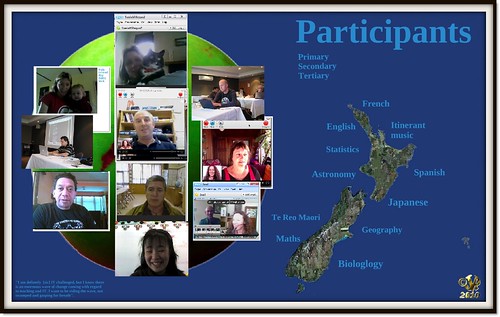
The VPLD programme offers flexibility of choice, time and approach, and is designed to fit in with what you are already doing as teachers and/or leaders.  Each participant is partnered with a mentor, with whom they meet online using Adobe Connect (a Web conferencing tool that enables interactive synchronous communication), or Skype, once a month for between forty-five to ninety minutes. The programme also provides professional learning through engagement in the VPLD professional online Community of Practice (CoP). The CoP offers a safe environment where you can discuss and challenge alternative points of view about pedagogy and practice, across disciplines and sectors.


The literature suggests that the duration and frequency of effective PLD are important - little and often over an extended period of time being the most effective. Participation in the VPLD programme is therefore over the course of three years. In the final year, you will be encouraged to develop your own mentoring skills, and are scaffolded to work with someone of your choosing in a mentor role.


The overall aims of the programme are to raise the professional knowledge and skills of participants, while also accelerating students' achievement of learning outcomes.


If accepted onto this programme you will develop your own learning goals around projects that interest you, framed within an inquiry process.


Find out more about the VPLD programme:


Please use this form to submit your expression of interest.


To discuss participation, for yourself or a colleague, contact Hazel Owen hazel.owen@core-ed.org, Rachel Roberts rachel.roberts@core-ed.org, or Clarrie Yates clarence.yates@core-ed.org.

fonikx iz not da cea to reedin

The phonics method of teaching children to read is not necessary past the initial stages of learning.


It would seem that phonics alone is no longer the answer to our ‘learning to read issues’.

What does it say about previoud generations of learners? Surely, if it is true of this NZ/Scottish generation then the same can be said of previous generations around the world. Were we wrong again? Will this prompt another cycle in the ‘roundabout’ of pedagogical ideas and implementation?

On a personal note, phonics worked for me, but then I struggled with reading and was diagnosed with dyslexia at 12 and classified ‘special needs’ for many years, right through my secondary schooling. Even I know that there is more to reading than simply knowing the phonetic structure and rules. There has to be a ‘whole text’, context driven, element to reading.

As an aside a while ago I was in discussion about ‘skimming and scanning’ text. It surprised me when a colleague talked of moving their eyes in vertical fashion down the centre of the page and then was able to pick out the key themes and ideas of a passage of text. No wonder I’m a slow reader. I seems can skim for keywords and phrases but not scan, it would appear. The redeeming feature of this disability of mine is that I can retain larger portions of text over a longer period of time, but then if I have to read every word its hardly a surprise.

Other articles:


Related posts:

Positive discrimination in education

Teachers throughout New Zealand are required to complete a ‘class profile’, identifying the learning needs and foci of their charges. The object of the exercise is to make distinctions along gender and ethnic lines in a bid to focus professional knowledge and experise upon the correct groups within your school. The research suggests that Maori and Pacific Islanders are, educationally, at a disadvantage and need positive and purposeful interventions to allow them to succeed.

Even as I write I sense the tone in this last paragraph which smells of racism. Positive discrimination, to be sure. But is that not PC racism.

A teacher should KNOW their learner; as individuals not as collective, discrete groups. The needs of learners are individual. Streaming, differentiation and grouping are all tools which are employed by teachers to support classroom management. These approaches are not to replace of personalized learning but are a means toward that end.

Teaching and Learning are not mutually exclusive. If they are then teachers have failed.
Learning without the teaching is unstructured, disorganized, chaotic, unmanageable and un-measureable. Teaching without Learning fails to meet the needs of students and does little for motivating learners toward independence.

Balance is required and the professional judgment call as to what that balance should be comes from knowing your learners.

Related articles:
Raising achievement rates of Maori and Pacific Islanders
Our kids should be choosing life