Michael is an author, international speaker and social
researcher on this very topic and the 7 myths he presents got me thinking.
Michael McQueen
Myth #1They are self-centred.
There are a couple statistics presented here: 81% of youth
aged 13-25 volunteered in the last 12 months and 69% consider a company’s
social and environmental commitment when shopping.If these two are to be believed then there are
a lot more engaged youth than I first thought.
Myth#2 They don’t
think about the future.
Youths perception of the future is different and preparing
for it has to be different. The key here is in the word ‘preparing’ rather than
‘planning’. Theirs is a vague future with ever shifting careers and skills
required. Much better they equip themselves with the skills and contacts they
need rather than trying to plan for a unpredictable future.
Myth #3 They have
moral compass
From over here that may be the perception but McQueen talks
about their understanding that there are no moral absolutes. Truth and morality
and seen differently by each individual. This had left them being more tolerant
and accepting of diversity than any previous generation.
Myth #4 The are
disrespectful
I have heard this one time and time again. But reality
paints a differnet picture. As far as Gen Y are concerned there is little
respect for piverledge or power or authority. Respect is built out of being
respected and out of a genuine relationship with the individual.
“being worthy of being respected is similar to being a nice
person… If you have to tell them you are, then perhaps you really aren’t.”
Myth #5 They are lazy
This one is tricky. There is totally different mindset
towards work with Generation Y. They have seen far too many heart attacks,
strokes and failed marriages. They are being their careers with clearer picture
about what work/ life balance is. They are committed to their work but not at
the expense of family, friends and the relationships that truly matter.
Myth #6 They only
communicate online.
It is true with Twitter, Facebook and MySpace, Pinterest and
other online communities there has been a huger connection being made around
the globe. But with the migration of people and the connecting through the
internet Gen Y’s mideset is shifting towards real relationships with real
discussion. Making connections with the older generation.
Myth#7 They don’t want
to connect with older generations.
They have often been referred to as the Fatherless
generation, with divorce on the increase and the blended family becoming the
norm its hardly a wonder that so many wonder where their roots are and are
crying out to make genuine connections with adults they can trust, look up to
and respect.
But Generation Y is getting older. They are no longer
filling our Primary schools and they are fast vacating our High Schools
too.Do some of these myths still apply
to this next generation? Are they the truly lazy? How are we going to address
the students in our care? There is much to consider and reason enough to look
for the good in our youth rather than assume the worst. What now? But what
next?
Celia Lashlie continues to be a quality speaker when on the topic of how dad’s should step up and mum’s step back if we’re going to stem the flood of boys ending up in prison.
Made wrong
In our currnet pareting scheme and education system boys are are made to feel wronf just be the mere fact of them being boys. Celia noted that sometimes a behavior is not inheretaly bad but simply a product of boy-ness. We should, as parents and teachers, learn to tell the difference between the two.
Given time and space
Far too often we exclaim “this is happening NOW” “Get your coat on, shoes, get in the car… let’s go, let’s go, let’s go” This approach is poor people management and when those people are boys… oh dear.
Instead, place things in a time frame. “Dinner is in 15 mins”, “ We’ll be leaving at the end of that programme.”
Boys can and do think reflectively but they may need more time, more support than your average daughter.
Tell truth to boys
Finding the simply language that matches the age of your son, your pupils, can be tricky. But telling the truth, putting boys ‘in the picture’ allows them to process the world better. We as adults have a wealth of knowledge and wisdom that our boys seem not able to access. The way we talk to boys needs clarity and conviction Truth wins out with boys over embellishment or exaggeration.
Think then Talk
Boys process and then talk or explain or ask as necessary. Women on the other hand talk out loud. Celia did this demonstration and my words would not do it justice but basically women, mums, teachers, talk through an issue and process it simultaneously. That’s a whole lot of talking that, to a boy, is irrelevant. No wonder they stop listening.
Digging down inside
Over the years, boys pick up on everything, they may not be able to articulate it but it is all stored deep inside. All we need is the questions (not too many) and the time to allow them to process what is asked and articulate an answer. Boys come across as lazy but the one thing they have access to is that knowledge that women WILL jump in and answer their own question before any thought is required on his part.
Give him the time to process, make him aware it is HE who has to answer, make time for it, let him know you’re not going anywhere until he’s answered – take a newspaper if you think it’ll take a while – maybe not.
In an election year, no less. The Principal’s Federation seems confident that some agreement can be reached about ‘off-limit’ areas of the education sector.
Western Bay of Plenty Regional PPTA chairman Jason Smythe is quoted in Sunlive as saying: “Change in the sector is usually due to political point scoring as opposed to what is in the best interest of our students. Teachers are left trying to pick up the threads of ill-constructed ideas which often see more administration rather than them being able to focus on their core role – teaching in the classroom.”
Currently, according to OECD figures New Zealand has the best education system in the world. That achievement has arisen through the current system as it stands. But without healthy debate and discussion and the right to protest and even ‘political maneuvering’ then we wouldn’t have the robust democratic process we have now. If Education were decreed ‘off-limits’ for political discussion then the outcome would be a slowing of change in education and a shifting of accountability that may or may not be healthier.
The level of debate over education needs increase, not decrease.
Statistics are impressive on one level but impersonal in another. Government looks at the biggest picture, its what ‘oversight’ means, but your kid is your responsibility. Parents can forget about statistics. Our children are not going to be meet the maths standard 46% of the time. Every child has a 50% chance of success regarless of the stats. They either will or won’t.
We should be asking “Does my child’s teacher know my child and cater for their needs?” If the answer is “Yes” then we can expect the best possible opportunity given to our children. We just need to ensure our child is ready to step up to the challenge and responsibility of making the most of their schooling.
It seems that the behavior of our our very youngest students is deteriorating.
Surely, at age five or six any blame directed at school or schooling practices is minimal.
Those early years are dominated by parenting and ECE.
Quality parenting skills are a prized treasure by one sector of New Zealand society and viewed as a complete waste of time by another.
Sterotypes are unhelpful here as both these views are help by people across the economic/ social/ cultural divide.
My point being that the importance of parenting skills and lifestyle choices continue to impact upon kids right through their childhood.
Again this article serves to highlight my point that it is the parent who should be the champion of their child’s education and teachers/ coaches/ tutors are mere subcontractors.
These passed two days has seen me meet in Wellington for discussions about access to web content for all.
Many blogsand wikis and websites are constructed by the physically able and have very little regard for those individuals with hearing or sight impairments trying to access content. When I say “many blogs” I am including this blog as chief among them.
There are many differences you may or may not be aware of if you compare this post with many previously. In this post I hope to highlight some ‘best practice’ principals that I have learnt over these last two days.
Creating the right heading structure
First amongst the changes are the number of headings you’ll notice. When writing on the web, or in WORD, you may have noticed the ability to label text as ‘heading 1’ , ‘heading 2’, ‘heading 3’ and so on. As pretty as these may look they actually serve a more serious purpose. This type of heading structure assists those visually impaired to navigate through your article. Just as ‘chapters’ in a DVD enable viewers to scroll through a movie more quickly or select the scene they desire so the navigation tools scroll through the article using these heading 1, heading 2, heading 3 as markers or reference points to guide the user to the most relevant paragraphs for them.
Making links meaningful
Many screen reader navigation tools have ‘links’ as a scrolling option for users but in many cases they don’t receive the in information they most desire. Instead a the voice reading stating “Link, getting the most the from a webpage” or “Link, further reading supporting accessibility of websites” all the user will hear is a string of “Link, read more” or “link, click here” which gives no guidance as to the content found at the end of the link.
Therefore it is advised that ‘click here’ or ‘read more’ are to be phased out with links becoming part of the main body of text, comprising of complete sentences.
Annotating images for accessibility
Using captions effectively
Figure 1 Rusted car in long grass
We are going to stay away from the issue of copyright and ‘where did you get that image?’ and move straight to the features of the image of an old car in long grass (figure 1) you see to the right. The first thing you’ll see is that it has a caption with a title which links it to this paragraph you are reading right now. Captions add meaning and context to images.
Alt-text to support understanding
What you can’t see, unless you have screen reader on is the ‘alt-text’. In a nutshell the alt-txt or alternative text to give it its full title is a brief description of content of the image. Alt-text is only included if the image or information contained on the image is significant in its support of the main body of text.
Alt-text for bling
Otherwise it can be simply ‘bling’. This is where the content of an image is merely there for aesthetic purposes and contains no content to actively support the article. Still the writer needs to make a conscious decision to add alt-text for this image even if it is only the word “null” so that those using electronic readers can identify ‘bling’ and know they are not missing out on important information.
Captioning and transcripts for video presentations
Our responsibility for providing quality video examples does not simply rely on quality camera work or clever editing. You will notice with the embedded video below it has closed-captions options and an embedded transcript. Writing a transcript of a video can be time consuming and tedious, however, it is essential if we are going to ‘raise the bar’ in accessibility. Youtube has a built in feature which supports in creating the time-coded captions from the transcript.
Today we arte going to be talking about accessibility for websites. Music. Whether we are responsible for writing a formal website or doing our own blog we need to be aware that there a certain group of people who access the internet in a different sort of way. They use screen readers and electronic Braille typers and all sorts of other different gizmos in order to access web content. Everything we post needs to be accessible. You know wen you are writing a blog post or you’re in some sort of editing tool you’ll notice at the top that it has by the side of font it has ‘normal’ ‘heading 1’, ‘heading 2’, ‘heading 3’ , normally it’s a drop down menu. Now these make your blog post look really, really pretty but they actually serve a more serious purpose. If someone is using a screen reader access your website then these headings clearly demarcate and help them to navigate through your website. That’s the way they skim and scan through your document. When one of those electronic voice, activation, tool, things. Stop captions now. When they are being used. One of the ways of navigating is to click through the links on a page. Now if we always write ‘read more’ or ‘click here’ or ‘see more’ and use those turns of phrases for our links that ‘s all they are going to here. And its going to make no reference at all to where that link ends up. So we need to get rid of those things and we need to basically make the link either a whole sentence or a portion of the sentence that when it is read by the screen reader they have a clear indications as to where that will take them. The next thing we have is what we have to do with images. It blew my mind when I was in the session. Essentially, there are captions, and descriptions and alt text. Alt-text is the one, you when you hover over an image and it comes up in maybe a yellow box or something like that. Sometimes it appears like that, and sometimes it doesn’t appear at all. It either needs to be a full bright sentence to describe what’s going on in the picture and why it is useful to the main article or it simply needs to read null. Or something like that. So its basically bling on your site. And when the screen reader goes through and the user is there they know that the image is just there to be pretty and I’m not missing out on anything to do with the main article and I’m just skipping passed this image. So now we’ve come to the portion about, well, basically, this video. Because what I’m hoping to do. First of all you should have been seeing captions of everything I’ve said. I’m not sure how they are going to spell *rasp* There should be a transcript attached to this post. Ok so, there is going to be more helpful links in the shownotes below. Don’t forget the closed captioning that we’ve got and don’t forget to subscribe at the top and good luck. Music.
Useful links
Web aim is about information, training, resources, guidelines and standards for Web accessibility and disability access to the Web. The World Wide Web Consortium (W3C) is an international community that develops standards to ensure the long-term growth of the Web. WAVE is a free web accessibility evaluation tool provided by WebAIM.
When asking Stephen Fry a question is a mere tweet away and being able to ‘Facebook’ ONE News or some All Black or other distance between ‘celebrity’ and the 'everyman' is narrowing, fast.
Gone are the days, far, far in the past, when politicians answered to their public via TV spot or Town Hall presentation.
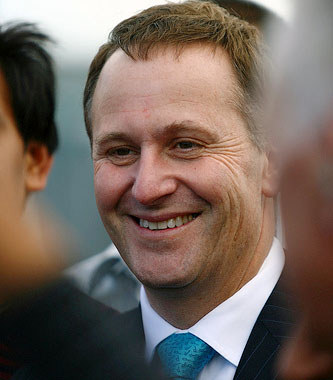
John Key’s personable nature and willingness to share ‘his personal opinions’ whether it be in meetings such as that described in the Otago Daily Times or with his regular Youtube updates, it certainly endears him toward the New Zealand public.
He shared:
"If you smoke, the blunt message is stop. Nothing is more sure to kill you than smoking."
His personal view [on purchasing alcohol] was 18 years in bars, restaurants and controlled premises and 20 years for off-licences.
Whether we agree with these positions or not they are very clear. Raising the level of debate in this country, surely that's a good thing.
The principal of Pukeokahu School, Marama Stewart, reflects on how the education system has changed and asks what we want for our children's future education.
She highlights some difference in the presentation of education:
Schools were formed to create batches of cookie cutter graduates that fit into an industrialised society.
if you were lucky you had one or two teachers who inspired you and broke the mould.
[we now] move away from this industrial model in order to meet the dynamic needs of our 21st century society.
New Zealand is already way ahead of the ball game when it comes to dynamic education, with it's world renowned New Zealand Curriculum.
[It is] really important that our community have a long hard think and begin a robust conversation about what we really want for our children in education.
I want the school I teach in to be a place that inspires children to shine in all areas of their life.
But then with an eight week term at the end of the year it might feel a short hop to the summer holidays, admittedly, reports need to be written and parents met with.
Hosting the World Cup does not come around often, I’ll be surprised if I see it again in my lifetime so its good to know that the country is behind this endeavor. With the school terms being manipulated this year the implication is that employers around the country need to also be more flexible as parents request annual leave to coincide with their kids vacation.
I guess, if the All Blacks win all will be forgiven.
There are many courteous road users in the provinces compared to the main centres of New Zealand but its not always the most helpful.
Understanding traffic and road safety doesn't necessarily come naturally. We need to teach our children how to be safe pedestrians. It's not just about telling them what to do - children learn from what adults do, so you need to model safe behaviour.
So with that in mind we took to the streets this afternoon. Whilst trying to train my 5 year old to cross the road with care I got somewhat frustrated by the number of drivers who saw I was with a child, slowed to a stop and waved us across.
They are good and kind people but I do not want to give my child the impression that cars stop for you when you are wanting to cross the road. Under no circumstances do I want him to be under the illusion that it is the drivers’ responsibility to ensure his safety.
We walked the city centre of Hastings looking for crossings and opportunities to talk about ‘sneaky driveways’, different places to cross and dangers of parked cars. I’m hoping he is a little wiser today but the trick to this is to take EVERY opportunity your can to reinforce these lessons. Here’s hoping we can take five more minutes in our journey to do it right.
Little eyes are watching and learning from actions.
Resources are available to assist us in educating our kids:
"Yes, I think here, [New Zealand] the women have … more opportunity for study and for work. I think in a company it’s not very different—the salary of a man and a woman. But in my country [Chile] for the same work, the woman is always paid less."
Wellington, New Zealand
Patricia Lara, 30, Chef from Chile
Although it has experienced a decrease in economic opportunity, political empowerment, and health equity, New Zealand remains No. 5, its rank for the past two years. It has eliminated 78 percent of its gender gap (down from 79 percent in 2008 and 2009) and has been in the top 10 since the beginning of the index. It has fully eliminated its education equity gap and is ranked No. 9 in economic opportunity, No. 91 in educational attainment, and No. 8 in political empowerment.
New Zealand is ranked fifth in the world reducing the gender gap and as quoted below is classified as having eliminated its education equity gap - if only it would be so on the 'Global Ethnic Gap'.
Politics, voting, elections, parties. These are not things with sexy titles. These are hardcore issues. Some would say essential to the future. My fear is that Georgina O'Reilly is right, but not just about her peers but the general public at large.
She ponders what would kindle the flame of interest in such issues.
The reality is that politics in New Zealand is dry and dull. John Campbell, Mark Sainbury and even Guyon Espiner can do there best but honestly, it never sounds that interesting at the best of times let alone for the 17 year olds.
Mail drops and flyers are hardly the most engaging media for today’s society.
What New Zealand lacks is two things:
A quality drama that engages and touches on political issues. – Similar to these offerings perhaps?
A top quality, comedian with an eye on the political arena – A Jon Stewart or Stephen Colbert after all America “hangs on their every word and statistics show that a great number of people in North America actually get their daily and political news from these comedians.”
The pool of politicians is small in New Zealand, they all can’t have affairs, spit on babies accidentally or have their cars totalled by a flash mob of angry farmers and their John Deere…
New Zealand as a whole needs waking up to politics. There is far to much of the ‘it doesn’t impact on me”. But the reality is that it ALL impacts on you.
Just from today (pdf): Smoke-free Environments (Controls and Enforcement) Amendment Bill – This Bill seeks to over turn previous legislation which banned smoking in public places. Airports (Cost Recovery for Processing of International Travellers) Bill – This Bill is a move by lobbyists of International airlines to shift payment of ‘administrative roles’ from the Airport tax they have to pay squarely on Auckland/ Wellington and Christchurch rate payers. Child and Family Protection Bill- The success of this Bill will mean that Fathers who have sole custody of daughters will have to be subjected to frequent and random visits from CYS workers even if they have no prior convictions of domestic violence or child abuse. New Zealand Security Intelligence Service Amendment Bill – This Bill will give the Security Services unrestricted right to bug and monitor any person or persons within New Zealand whom they deem to be ‘persons of interest’. Television New Zealand Amendment Bill – This Bill has been written to reestablish the need for TV licences in New Zealand. As Freeview becomes the primary delivery system of TV broadcast to lower income homes licencing will ensure the future of New Zealand OnAir.
These are items which appeared on todays ticket for debate and consideration in Parliament. How I described those Bills, is that what they are really about? I don’t know. Can I find out? Not easily. Have I the time to put into investigating these Bills? Probably not. Have I voted in persons who I think can best represent my view? Yes.
The point is we have to have our say at election time or we have no right to winge and moan about the news for the next four years... or is it three??
I, personally, am now one step removed from the day-to-day classroom experience but it was only last year when I sat amongst my colleagues in the staffroom and discussed the progress and behavior of our charges.
Mike makes a few valued points in his argument and I’m interested to hear of opinion on this issue from both teachers and parents.
He states:
There are good teachers and dodgy one.
There is no reward for good performance as a teacher so there is a lack of motivation.
Is there another job anywhere where talent and individual expertise are ignored and not rewarded?
This model of 'one size fits all' is damaging to the profession.
The argument that allegedly teachers can’t cope with being in the staffroom knowing that they might be paid different amounts depending on their performance is a monumental indictment on the maturity or lack of it in your average teacher.
Then he ends with..
“And the concept that it’s a vocation, it’s a calling and you should be simply grateful to polish young minds is a tired old excuse for not actually dragging the profession into the real world.”
There are two lines of argument about wages and bonuses.
That it is essential to pay staff sufficiently so the worry of finance is removed and the focus can be placed upon delivering quality service.
The use of financial gain as a key motivator in the drive toward providing quality service.
Perhaps teachers should be paid for results based on performance indicators established by the Teachers Council and by results of standardized testing?
But then there seems to be something wrong with the motivation of money as Daniel Pink illustrates in the video below.
Word on the street says, I mean the briefest of mentions by RadioNZ, that the Education Review Office and Qualifications Authority are to merge in a major culling of the Education Sector. Jobs in both departments will be lost in the shuffle.
It would be remiss of me to not mention the opportunity to take a ‘SURVIVOR- Education’ stance to it. Where two equally matched teams battle it out over paperwork shuffling, cheek-blowing, head-shaking and under-the-breath muttering challenges. Each week members of the team would pick someone to be voted out by the viewing masses.
Perhaps I’m letting this thing run away with me.
On a more serious note, I am a little unclear as to what the merger will look like.
Two completely different roles to the layman looking in. But then, who am I to say?I assume that greater minds than mine have grappled with that question...right?
First there is the opinion that John Key out of touch with parents when it comes to Early Childhood eduation. Then we have Dunedin literally haunted by the spectre of budget cuts past.
“The impact was evident in an advertisement Dunedin's Little Wonders centre placed in the Otago Daily Times on Saturday. It was seeking an "untrained early childhood teacher", which raised the ire of New Zealand Teachers Council director Dr Peter Lind, who was "concerned" about the wording of the advertisement. He questioned if people would be happy to see a medical practice advertise for an untrained doctor.”
It is my opinion that stating ‘untrained’ in the advert is merely antagonistic and is not at all appropriate. But to equate that with advertising for an ‘untrained doctor’ is a bit of a push. I’m sorry but nobody died due to a poor choice in maths game.
It is interesting to note the number of adverts for Scale A classroom teachers stating ‘New Zealand registered teacher’. Do we raise an eyebrow at that? Is that discriminatory? Is that not a clever wording for ‘we’re not taking untrained teachers’? Is not practically racist?
I would question what parents are looking for in an ECE centre. I wonder how many genuinely choose one centre over the other based upon the number of qualified staff and how many simply factor the ‘feel’ of the centre.
NOTE: I have no idea how many, or which, staff were qualified at my son’s centre – but then maybe I’m a terrible father.
The article is written in such an emotive way as to enflame the debate over Maori youth.
Perhaps the figures indicating that Maori youth suicide is effectively double what it should be, representing 20% casualties. However, there was no reference to the remaining 80% and how they breakdown in terms of ethnicity.
Disappointingly, there is only quoted reference to the study carried out by Terryann Clark. I for one would have liked to have gone and read some of the source material.
I’m not saying Maori youth suicide is not a tragedy. Far from it. Youth suicide is tragic period. I mourn the loss of a single life from such a totally preventable manner.
There is clearly a disconnect between many youth and their parents. Without the feeling of unconditional love that we can only receive from our parents then life can be brutal. Friends are friends, but they still can let us down. Teachers play their role as do social workers and pastoral care workers, yet still it is the closeness of family that really counts.
Kids need to feel wanted and needed. Even during times when they themselves refuse to acknowledge that need. Through the good and the bad family needs to be there.
Today’s families look very different to those a few years back. But regardless of what a kids family is made up of they need that safe place to be alone. To be with those who will love them regardless. Provided that ‘home’ is a supportive place then we all can bear the trials of the wild-world outside.
Let us all love, support and care for those kids in our care.
Given the inevitible CO2 impact that would follow were the current focus on coal and oil exploitation to go ahead as a panacea for our nation's financial challenges, Hansen's visit is an opportunity for the local climate change/global warming conversation to have a champion of excellent scientific credentials who has been asked to explain the risks to several White House incumbents.
How much responsibility should be placed on the the individual and how much upon their peers?
There must be a thousand factors impacting upon the events surrounding the teenagers death. Some immediate and some from long ago.Where to from here?
Again this is a time for us all, from all sectors of society, to take a long hard look at our responsibilities.
Law makers, law enforcers, teachers, parents, social workers, off-licence owners, bars and puts and club owners, friends and relations.
We should all play our part.
I would have liked to have spent time reflecting on this TED Talk but to be honest I’m too selfish and frankly, have better things to do with my time than do your thinking for you. Besides, I only have rudimentary education myself, these are weighty issues and I’m too stupid to process them.
So feel free to open reflective discussion in the blog comments below, unless, like me you’re too lazy.